Posts

Reflections from the Pastor: For All the Saints: Witnessing for Jesus

Image
Read the Acts passage here: Acts 1:1-11 For All the Saints: Witnessing for Jesus I suspect that the title of this sermon/reflection might have surprised some of you.   “Witnessing” is not a word that Lutherans use very often.   In fact, the idea of “witnessing for Jesus” makes many of us Lutherans just a little uncomfortable.   But why is that?   I suspect that it is because that the word has been co-opted in ways that refer to a very specific kind of behavior, and this behavior makes us very uncomfortable.   For most of us, the word “witnessing” refers to a type of in your face, aggressive religious marketing.   “Witnessing” makes us think of people going door to door, or passing out tracts or coming up to us at a mall or some outdoor event and essentially saying – “You need to believe what I believe, otherwise you are going to be lost forever.”   Scare tactics and belligerence, my way or the highway – all of these come to mind when we th...

Reflections – Called to be a Community – I Corinthians 13

Read the text here: I Corinthians 13 Most of us are used to hearing the text of I Corinthians 13 read at weddings.   In fact the passage – usually the entirety of chapter 13 – has really become associated with weddings.   And it certainly is appropriate.   St. Paul’s lifting up of self-giving love as a model for a marriage relationship is certainly what couples should be encouraged to strive towards.   So it may come as a bit of a surprise to learn that Paul did not have marriage in mind when he wrote the words to I Corinthians 13.   In fact, he is not talking about marriage at all, he is talking about community.   Specifically, he is addressing this basic questions: How do we live in community? The church in Corinth was having problems with community.   They simply could not adjust their community life away from the cultural and societal values and expectations that had been a part of their lives before they became Christia...

Reflections on the text – Luke 17:5-10

Read the text here: Luke 17:5-10 Just Do It The disciples really have it tough in the Gospels.   In this passage from chapter 17, Jesus is continuing on the road to Jerusalem that had begun back in chapter 9 and he has been pushing the disciples hard.   There have been parables like the Lost Sheep, the Prodigal Son, the Good Samaritan, the Rich Man and Lazarus, the Dishonest Steward – all of which have turned their world upside down: forgiveness that is freely available, turning away from the pursuit of riches, a hated Samaritan as a model of faith.   In addition to that, Jesus has bluntly condemned the accumulation and focus on wealth and possessions and has even suggested that in order to be a disciple one needs to give up ALL one’s possessions.   He has taught that family obligations are to be secondary and that to follow Jesus is to pick up a cross and follow to crucifixion!   And he has continued his distressing and alienating habit of healing ...

Reflections on the Parable of the Dishonest Steward – Luke 16:1-13

Image
Read the lesson here: Luke 16:1-13 Keep Your Eye on the Ball! Of all of Jesus’ parables this one is perhaps the most difficult to understand.   A quick reading of this parable gives us the impression that Jesus is calling on his disciples to act more shrewdly even to the point of dishonesty!   So, what is this parable about?   It all seems so straight forward at first: A steward gets in trouble for “squandering” or mismanaging and is told he will be terminated.   The steward, recognizing his complete unsuitability for physical labor comes up with a ruse to ingratiate his master’s debtors to himself.   So he reduces the amount of the debts, collects the remainder of what is owed and earns the appreciation of the debtors.   We expect that when the master finds out what he has done the steward will get punished in the end.   But no, the master commends the shrewdness of the steward and Jesus finishes up by talking about the dangers of focusin...

Reflections on the text: Luke 15:1-10 (32)

Image
Read the complete text here: Luke 15:1-32 Come, Join the Party! “… But when you give a banquet, invite the poor, the crippled, the lame, and the blind. 14 And you will be blessed, because they cannot repay you, for you will be repaid at the resurrection of the righteous.”   Luke 14:13-14 Who doesn’t like a party?   Who doesn’t like a time to relax with friends, eating and drinking and having a fun time?   Jesus certainly seems to love to party.   In the Gospel of Luke he seems to go from one party to the next.   In fact, Jesus will accept an invitation from anyone – Pharisees, Scribes, tax collectors, sinners of different kinds, people of differing classes and backgrounds (see quote above from Luke 14).   Jesus will party with anyone!   And that is one of the things that gets him in trouble.   The good and respectable people don’t like it!   Maybe it’s jealousy or self-righteousness, but when Jesus accepts party invitations fr...

Reflections on the text – Luke 14:25-33

Image
Whoever comes to me and does not hate father and mother, wife and children, brothers and sisters, yes, and even life itself, cannot be my disciple. Whoever does not carry the cross and follow me cannot be my disciple… none of you can become my disciple if you do not give up all your possessions.  Luke 14:26-27, 33  Read the full text here: Luke 14:25-33   Counting the Cost Is Jesus serious?   What strong language – we are to hate not only our family but even our own lives and give up all our possessions?   That seems like a prescription for loneliness and homelessness.   Surely Jesus is not serious! He must be using those words for effect, to make a point – right? That is the most common and comfortable way of looking at this passage – Jesus doesn’t really mean it – Jesus is talking to people who are really dense and he has to use these extreme examples in order to get the message through.   Well, perhaps, but I think we should...

Reflections on Healing in the New Testament:

Image
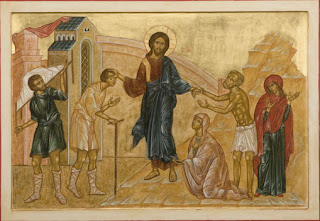
What is healing?   Why do we do a “healing” liturgy on the 5 th Sunday of the month?   Are we offering “cure?”   No, God has given us the gift of medical science to help us find cures. So then what is the “healing” that our liturgy offers us from God through Christ? It is easy to mix up those two words – healing and cure.   Our culture tends to under of “healing” as “cure,” and “cure” as “healing.”   Cure and healing are interchangeable in our society.   We go to the doctor for a cure in hopes that we will be healed of whatever ails us.   We come to church and experience a liturgy of healing in hopes that this will aid in providing a cure.   But are they the same thing?   No, in the Bible they are not the same thing at all.   They may be related, but they are two separate things.   Here then is a statement that sums up the biblical view of healing and cure: First, One can be cured without experiencing healing ...